Real Life Science with Tahuna Science Stalwart
More the 16 years ago Andrew Innes started giving up his time to work with Tahuna students. After all these years he continues to work with keen Tahuna scientists. Another big thanks is to Port Otago for the generous funding for the new YSI.
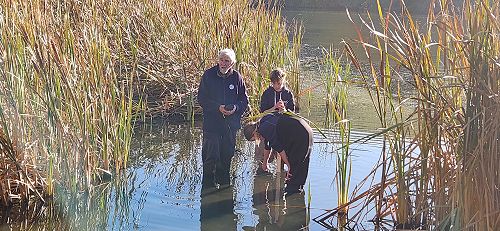
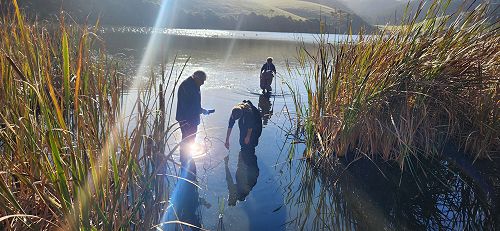
Last Wednesday we went with Mr Scoles to the lagoon. At the lagoon, we meet Dr Jonathan Kim, who tests the health of the lagoon. Dr Kim also has a PHD in oceanography, which is really helpful. We also saw Dr Murray Vickers, who does similar things to Dr Kim, except he has a PHD in chemistry and he taught at Columba College, then we met Andrew Innes, who is the creator and leader of the Tomahawk lagoon citizen science project. Eve and Jamie went into the water with waders on to collect water samples for Benji, Angus and Julian to test.
After we gave them the water samples to Benji and Julian, we went into the water to use the new YSI (Yellow Springs Instrument) that was kindly brought for us by Port Otago. Then Eve swished the probe (also called the sensor ) in the water and read out the water temperature, dissolved oxygen, electric conductivity and oxidation. While Jamie went into the water to test the water levels, the water was 35 cm tall.
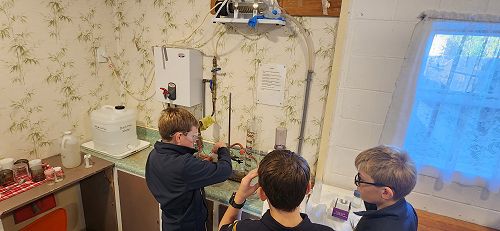
Julian, Angus and Benji started filtering all the micro water weeds out of the water to filter the waterway had to put the unfiltered water into a suction filter and wait for 1000 ml of water to filter.We froze the filter paper for the scientists to study,we bottled the filtered water for Dr Kim to analyze. We had to filter water from three different sites, we also had to collect a turbidity sample and two bacteria samples,a depth reading and a YSI reading.
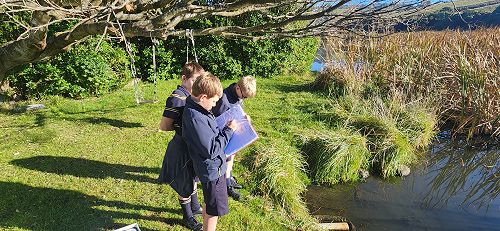
At Tomahawk Lagoon, there is lots of wildlife. We counted approximately 115 black swans. There were many Scaups, but they were hard to count. So we couldn't get an exact amount. Surprisingly, there weren't many Mallards, and we saw one Piwakawaka.
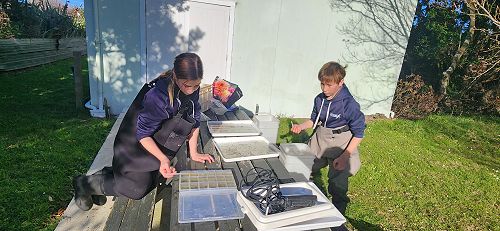
Then Jamie went deeper into the water to scrape the bottom of the lagoon with the bug net and then he brought the net back to put into the buckets that were filled with water, so the bugs didn’t die. Then we emptied the water and bugs into white trays so we could use the pipette to suck up any bugs we found and sort them into small sections. This allowed us to count them. We found a freshwater shrimp, a very interesting dragonfly larva and even a fish!
Written by
-Benji Rowe R1, Julian Boddem R 16, Angus Middleton R1, Eve Cooper R10 and Jamie Coppola.
Gallery